Fondo Europeo de Desarrollo Regional
Una manera de hacer Europa


Fondo Europeo de Desarrollo Regional
Una manera de hacer Europa
Posted at 11 Jul 2023
The Innovaugas project allowed to reduce up to 30% the energy consumption of the treatment plants of Baiona, Nigrán and Gondomar and to avoid the emission into the atmosphere of CO2 equivalent to that of 2,200 diesel vehicles.
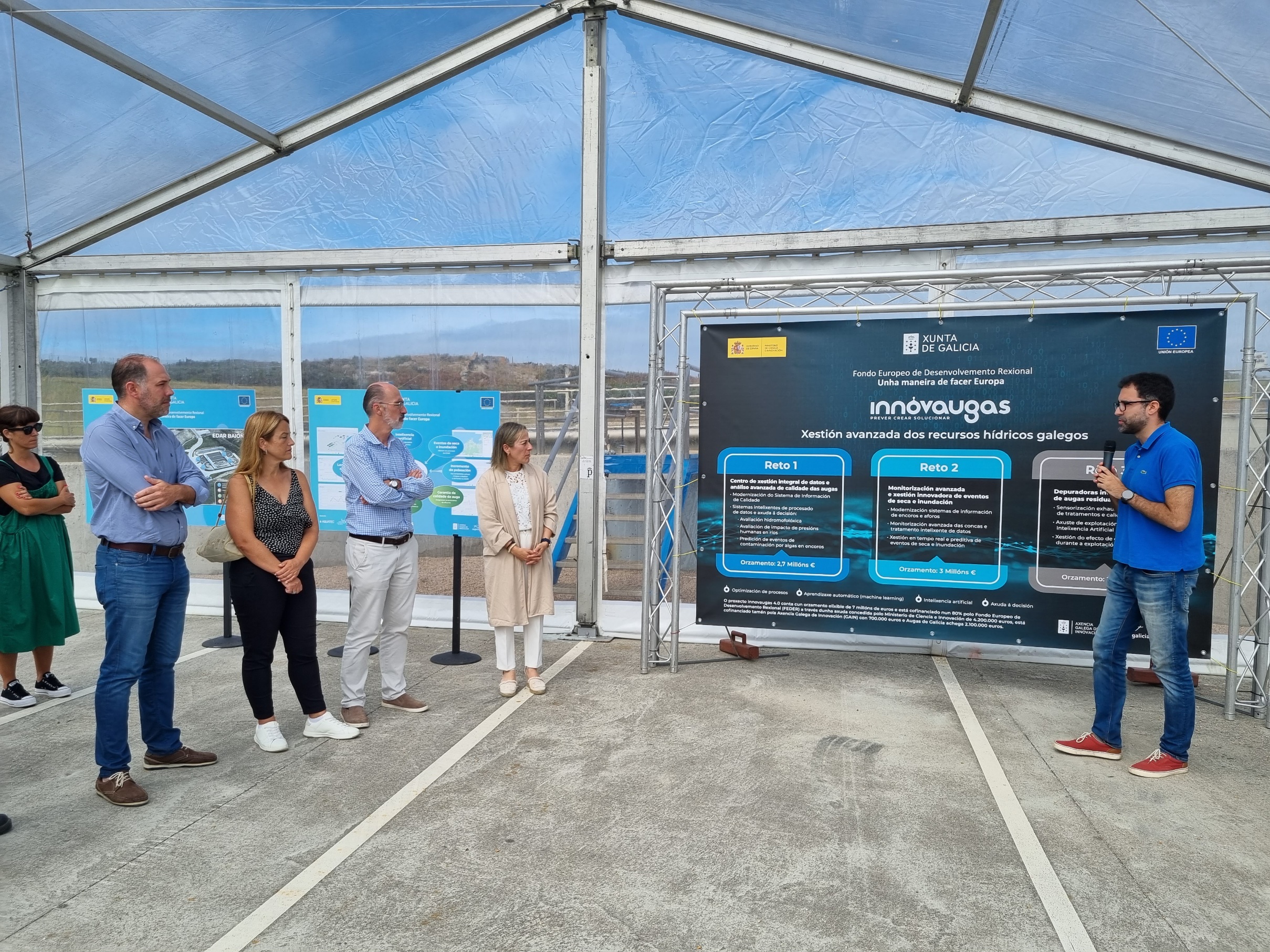
The Regional Minister of Infrastructures and Mobility, Ethel Vázquez, together with the mayor, Jesús Vázquez Almuíña, visited today the treatment plant of Baiona to present the results of the energy consumption optimization system that was developed in the framework of the Innovaugas program.
He explained that this pioneering project, aligned with the Galician circular economy strategy, is aimed at achieving intelligent wastewater treatment plants. Thus, it was initially activated in the treatment plants of Gondomar, Nigrán and Baiona, as a pilot project.
He explained that the technical solution to reduce energy consumption in these plants is based on an innovative artificial intelligence operation system. Each treatment plant is equipped with sensors that continuously evaluate its status and operation and monitor the quality of the wastewater at the plant's inlet.
More specifically, there are 3 levels of control: a first level with devices that collect information in real time on the purification processes and consumption; a second level that integrates intelligent control algorithms in real time for the different processes and establishes procedures to optimize their operation; and a third level that collects data and provides feedback for decision making with simulations.
With all the data collected, artificial intelligence contributes to decision-making in the operation of the treatment plant, allowing greater efficiency in energy consumption while maintaining the required quality of the water that is finally discharged into the environment.
The conselleira pointed out that this system has been in operation for 5 months in the aforementioned treatment plants, and that the emission into the atmosphere of more than 147,500 tons of CO2 per year has been avoided.
He specified that in the Baiona plant a reduction in energy consumption of 30% was obtained, registering in the three treatment plants in which the system is implemented an average reduction of 10%.
He explained that in June it was decided to implement and test this system at the Ponte Caldelas treatment plant, a much smaller plant with only physical-chemical treatment.
At the Ponte Caldelas treatment plant, the equipment is just being installed, so this system is in the testing phase. In the coming months, until October, the validation phase will be developed, which will allow to know if the results achieved are optimal and if it is feasible and appropriate to replicate the deployment of the system in similar treatment plants.
He advanced that this energy consumption reduction system could be replicated, not only in other of these 28 wastewater treatment plants operated by the Xunta, but also in the treatment plants operated by the municipalities, as it is a useful tool to lower consumption and reduce energy costs.
He insisted that, if this system were deployed in all the treatment plants with more than 2,000 inhabitants in Galicia and the desired savings were achieved, a reduction in emissions equivalent to that of all the diesel vehicles in the province of Pontevedra would be achieved.
He valued the step taken by the Xunta to advance in the constant objective of improving the management of the integral water cycle in Galicia and towards the energy neutrality of the wastewater treatment plants.
The Innovaugas 4.0 project has a budget of 7 million euros and is 80% co-financed by the European Regional Development Fund (ERDF) through the Spanish Pluri-regional Operational Program (POPE) 2014-2020.